



Let’s be clear — there is no “perfect timetable.”
There is only a timetable you can actually follow every day.
Most aspirants fail not because of lack of time, but because of unrealistic planning and zero consistency.
This is a practical, proven structure you can follow long-term.
Why Most Study Timetables Fail
Before jumping into the schedule, understand the problem:
- Planning 12–14 hour study days
- No time for revision
- Ignoring answer writing
- Overloading subjects in one day
Result: You quit within a week.
The Ideal Study Hours (Reality, Not Fantasy)
- Beginners: 5–6 hours
- Serious aspirants: 6–8 hours
- Full-time dedicated: 8–10 hours (only if sustainable)
If you can’t maintain it for months, it’s useless.
Core Principles of a Good UPSC Timetable
- 2–3 subjects per day (not more)
- Daily revision slot
- Daily answer writing or MCQ practice
- Fixed study blocks (not random studying)
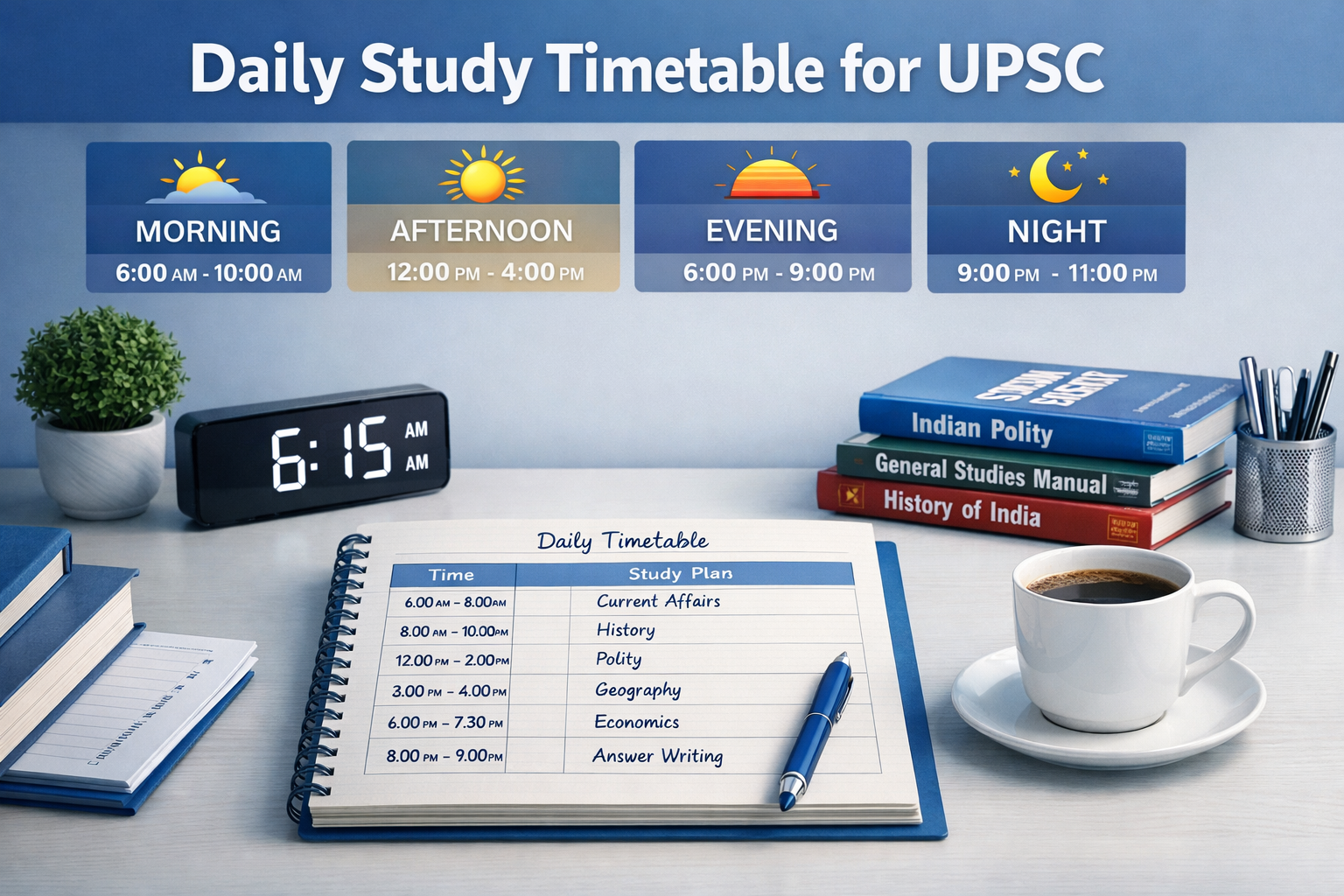
Realistic Daily Timetable (Model Structure)
Morning Session (Fresh Mind = Heavy Subjects)
7:00 AM – 9:00 AM
Primary Subject (e.g., Polity / History)
Focus on concept building and core study
9:00 AM – 9:30 AM
Break (don’t scroll social media endlessly)
9:30 AM – 11:00 AM
Second Subject (e.g., Geography / Economy)
Midday Session (Light + Current Affairs)
11:30 AM – 12:30 PM
Newspaper + Current Affairs Notes
12:30 PM – 2:00 PM
Break / Lunch / Rest
Afternoon Session (Practice + Application)
2:00 PM – 3:30 PM
Answer Writing Practice (Mains)
or
MCQs Practice (Prelims)
3:30 PM – 4:00 PM
Break
Evening Session (Revision Focus)
4:00 PM – 6:00 PM
Revision of what you studied earlier
This is the most important slot — don’t skip it
Night (Optional Light Study)
8:00 PM – 9:00 PM
Light study (notes revision / optional subject / weak areas)
Weekly Adjustment Strategy
Don’t follow the same routine blindly.
- 1 day per week → Full revision
- 1 day → Mock test + analysis
- Rotate subjects to avoid burnout
Subject Distribution Strategy
Don’t study everything daily.
Example rotation:
- Day 1: Polity + Geography
- Day 2: History + Economy
- Day 3: Environment + Revision
Repeat cycle.
Biggest Mistakes in Timetable Planning
- Copying topper schedules
- No buffer time
- Ignoring revision
- Studying randomly without slots
- Overestimating capacity
How to Actually Stick to the Timetable
Be honest:
- Start with fewer hours and increase gradually
- Track daily progress
- Cut distractions (especially phone usage)
- Don’t aim for perfection — aim for consistency
Final Strategy
A timetable is not about looking productive.
It’s about being consistent over months.
If your plan is:
- Simple
- Repeatable
- Flexible
Then it works.
If it’s complicated, overloaded, or unrealistic — it will fail.
Brutal Truth
You don’t need a better timetable.
You need to follow one timetable consistently.
Most aspirants keep changing plans instead of executing them.
That’s why they stay stuck.